The Bank of Canada has cut its overnight rate seven times since June 2024, landing at 2.75% in early 2026 — the lowest it's been since before the rate hike cycle began. The federal government extended 30-year amortization to all first-time buyers on CMHC-insured mortgages in December 2024. And Mississauga's newcomer population continues to grow, adding sustained demand in neighbourhoods where Indian families have been buying for two decades. So is 2026 a good time to buy here?
The honest answer: it depends entirely on your price point, your neighbourhood, and how your mortgage qualification math actually plays out. This guide breaks down current prices by home type and neighbourhood, explains the mortgage rules that matter most to newcomer buyers this year, and walks through the step-by-step process for purchasing your first home in Mississauga. We advise immigrant families through this process every week from our Mississauga office — so what's here reflects what's actually happening in the market right now, not what worked in 2021.
Key Takeaways
- The Bank of Canada cut rates 7 times from June 2024 to early 2026, bringing the overnight rate to 2.75% — mortgage payments are meaningfully lower than they were at the 2023 peak (Bank of Canada, 2026).
- 30-year amortization is now available for all first-time buyers on CMHC-insured mortgages (December 2024) — reducing monthly payments by approximately 10% vs a 25-year term at the same rate.
- Mississauga detached homes average approximately $1.35M in 2026; condos average ~$635K — entry-level ownership is still achievable for dual-income newcomer households (TRREB, 2026).
- Established immigrants own homes in Canada at a 69.7% rate — higher than the Canadian-born homeownership rate (CMHC Newcomer Housing Report, 2024).
- Permanent residents are fully exempt from Canada's Foreign Buyer Ban and can purchase any property type under standard CMHC rules from day one of landing.
Is Mississauga Worth Buying In vs. Toronto in 2026?
For newcomer buyers specifically, Mississauga consistently delivers better value per square foot than Toronto proper — while offering GO Transit access that puts Union Station within 25–30 minutes of most major corridors. In 2026, Mississauga detached homes average roughly $200,000–$300,000 less than equivalent Toronto properties in comparable neighbourhoods, according to TRREB's 2026 Market Watch reports (TRREB, Market Watch May 2026). That spread represents a meaningful difference in minimum down payment, mortgage carrying cost, and total equity trajectory over a 10-year hold.
But Mississauga's advantages for newcomer families go beyond the price gap. The Peel District School Board includes several of Ontario's consistently top-ranked elementary and secondary schools in Erin Mills, Meadowvale, and Streetsville. The Hurontario LRT, now open, has added transit density along the Hurontario corridor that historically raises property values by 10–15% near stations within three years of opening. And for Indian families — Mississauga's Malton, Meadowvale, and Square One districts have established South Asian communities with temples, Indo-Canadian grocery stores, and cultural infrastructure that ease the first years of settlement significantly.
The fair caveat: Mississauga isn't cheap. Detached homes clear $1M in virtually every neighbourhood. But with rate cuts in effect and 30-year amortization now available, the monthly carrying cost for a newcomer with 10–20% down has dropped enough in 2026 to open segments that were effectively closed in 2022–2023.
What Are Home Prices in Mississauga in 2026?
In 2026, Mississauga's real estate market reflects a measured recovery from the 2022–2023 rate-driven correction, sustained by seven Bank of Canada rate cuts and continued newcomer demand. Based on TRREB's 2026 Market Watch data, the average sale price across all Mississauga property types sits at approximately $1.05M — but that headline figure masks the wide spread between segments (TRREB, Market Watch May 2026, trreb.ca).
The condo market around Square One, City Centre, and Port Credit represents the realistic entry point for most newcomer buyers. A $635K condo with 10% down ($63,500) and CMHC insurance requires a gross household income of approximately $120,000–$135,000 under the 2026 stress test — achievable for dual-income newcomer households in tech, finance, engineering, and healthcare roles common among Indian immigrants in the GTA.
Townhouses in the $875K range shift the math: 10% down is $87,500, and qualifying income moves to approximately $160,000–$175,000. But freehold townhouses in Meadowvale, Churchill Meadows, and Lisgar consistently outperform condos on appreciation — and offer the backyard space that families with children prioritize over urban amenities.
Which Mississauga Neighbourhoods Should Newcomers Consider?
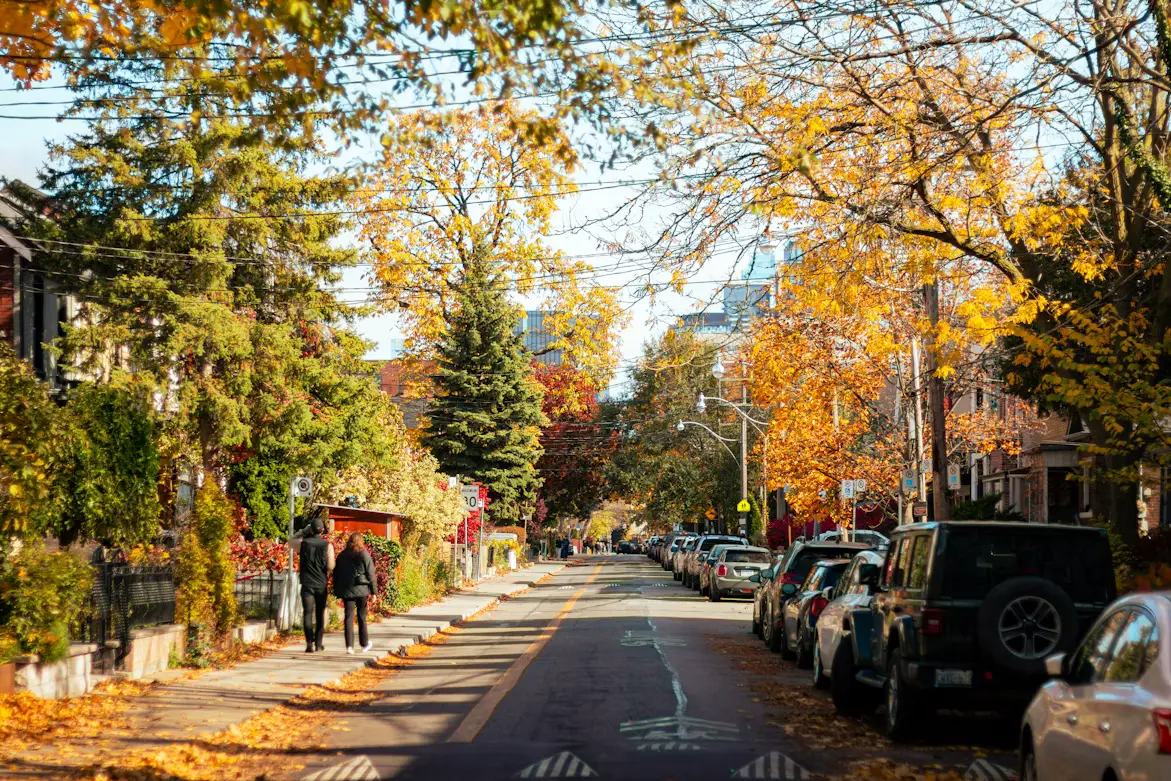
No two Mississauga neighbourhoods price the same — and for newcomer families, community infrastructure often matters as much as the per-square-foot cost. The city's south end is waterfront and premium; the north and west corridors offer more space per dollar with strong South Asian community presence (TRREB, 2026).
Square One / City Centre — Urban entry point, LRT corridor
Average price: $620K–$680K (condo). The Hurontario LRT's anchor station sits here, with Square One mall, Celebration Square, and the highest walkability score in Mississauga all within a 10-minute walk. Dense condo inventory and lower total mortgage size make this the most accessible neighbourhood for newcomers still building Canadian credit history. The area is culturally diverse and skews young — a natural fit for professionals relocating from India who want urban living without Toronto's price premium.
Port Credit — Waterfront premium, long-term appreciation
Average price: $1.4M+ (detached), $750K+ (condo). Port Credit GO Station puts Union Station at 25 minutes by express train. The neighbourhood is walkable, waterfront-adjacent, and home to Lorne Park Secondary — one of Peel's top-rated high schools. Premium pricing reflects both lifestyle and transit value. Best suited to established newcomer professionals looking for strong long-term equity, not first-time buyers maximizing square footage per dollar.
Erin Mills — Top school catchment, family suburb
Average price: $1.1M–$1.3M (detached), $900K–$1.05M (semi). Erin Mills is the most popular choice for Indian professional families with school-age children, and the pricing reflects the school-district premium. John Fraser Secondary and Gonzaga Catholic are within the catchment and both carry strong university acceptance rates. Credit Valley Hospital, Erin Mills Town Centre, and multiple Hindu temples make this a practical anchor for extended family settlement. Expect bidding competition in the detached segment even in 2026's more balanced market.
Meadowvale / Churchill Meadows — Value, growing South Asian community
Average price: $950K–$1.1M (detached), $800K–$875K (townhouse). Newer development in west Mississauga with more value per square foot than Erin Mills, strong highway access to Brampton employers along the 401/407 corridor, and an established South Asian community that has grown significantly since 2015. Churchill Meadows in particular draws Indian IT and pharma professionals whose employers sit along the Mississauga–Brampton employment belt. Townhouses here are the sweet spot for newcomer families targeting more space without crossing the $1M threshold.
Malton — Entry-level, established South Asian hub
Average price: $780K–$920K (semi-detached, older detached stock). Mississauga's most affordable ownership market for families. Malton has a deep-rooted Punjabi and South Indian community with gurudwaras, temples, South Asian grocery stores, and community organizations that make settlement genuinely easier. School ratings are lower than Erin Mills or Meadowvale — families with school-age children should review specific school profiles before buying, as the catchment varies significantly street by street. Long-term upside is meaningful as north Mississauga development continues and the Finch LRT extension reaches closer to the area.
What Mortgage Rules Apply to Newcomer Buyers in Canada in 2026?
In December 2024, the federal government extended 30-year amortization to all first-time buyers purchasing any insured (CMHC-backed) property — not just new builds (CMHC, Homebuying in Canada Guide, cmhc-schl.gc.ca, 2025). This is the most significant newcomer-friendly mortgage rule change in years. Stretching from 25 to 30 years reduces monthly payments by approximately 9–11% on the same loan amount — which can be the difference between qualifying and not qualifying at current home prices.
Down Payment Rules in 2026
Down payment requirements scale with purchase price. For a $635,000 condo — Mississauga's average — the minimum calculation works out to: 5% of the first $500,000 ($25,000) plus 10% of the remaining $135,000 ($13,500), totalling a minimum of $38,500 to get into a Mississauga condo. For any home priced at $1,000,000 or above — which includes most detached and semi-detached properties — the minimum is 20%, no CMHC insurance available. On a $1,350,000 detached home, that's $270,000 minimum down.
Newcomer-Specific Mortgage Programs
Three programs reduce the barrier for newcomer buyers with limited Canadian credit history. CMHC's Newcomer Mortgage Program allows qualification with fewer than two years of Canadian credit history — you substitute foreign income documentation and a letter of employment. The major Canadian banks — TD, RBC, Scotiabank, and BMO — each run dedicated newcomer banking programs that accept foreign employment letters, home-country credit bureau reports, and as little as six months of Canadian banking history alongside PR status. And the First Home Savings Account (FHSA), available to Canadian residents including permanent residents, allows up to $8,000 per year (lifetime maximum $40,000) in tax-free savings designated for a down payment — a meaningful advantage for newcomers who've been in Canada for two or more years and have been contributing.
One pattern we see consistently at Watts Group: newcomer buyers who arrive with substantial foreign savings often qualify more easily than their Canadian counterparts with identical incomes, because they can bring a larger down payment to the table — reducing the loan-to-value ratio and sometimes bypassing CMHC insurance entirely. If your home-country savings translate to 20%+ of a Mississauga condo or townhouse price, you're in a stronger position than you might expect. The challenge is documentation: Canadian banks want to see the source of those funds, typically three to six months of foreign bank statements and a signed declaration. Have these ready before your mortgage appointment.
Step-by-Step: How to Buy Your First Home in Mississauga (2026)
CMHC estimates the average first home purchase takes 6–12 months from initial planning to closing for newcomer buyers — primarily because document gathering and mortgage pre-approval take longer without established Canadian credit history (CMHC, Homebuying in Canada Guide, 2025). Starting the process before you've found a specific property gives you a significant advantage.
Confirm Your Eligibility and Gather Documents
Before speaking to any lender, confirm your PR card or COPR is in hand and your SIN is active. You'll need your Notice of Assessment (NOA) from the CRA if you've filed a Canadian tax return, or a letter of employment on company letterhead with your salary if you recently landed. For foreign income, gather 2 years of foreign tax returns and employment confirmation letters translated to English. Also collect: 3–6 months of Canadian and foreign bank statements, a copy of your passport, and proof of your current Canadian address (utility bill or lease). This document package is what every mortgage lender will ask for — assembling it once saves time across multiple broker conversations.
Get Pre-Approved Through a Mortgage Broker (Not Just Your Bank)
Visit 2–3 mortgage brokers rather than only your own bank. Brokers access multiple lenders simultaneously and know which institutions are most flexible on newcomer income verification — your personal bank may decline based on credit history criteria that a broker-referred lender would approve. A pre-approval letter is valid for 90–120 days and locks your interest rate for that window. With Bank of Canada rates at 2.75% in 2026, variable-rate mortgages are competitive again — but ask your broker to model both fixed and variable scenarios against your income stability and how long you plan to hold the property before deciding.
Work With a Realtor Who Knows Mississauga's Newcomer Market
A REALTOR® with regular newcomer buyer experience understands details that MLS listings don't capture — which Erin Mills streets fall in the John Fraser catchment versus a lower-rated secondary, which condos near Square One have flight path noise from Pearson, and which townhouse developments have special assessments pending. Ask specifically whether the agent has worked with Indian or South Asian buyer clients in the last year, and ask for references you can call. Buyer representation costs you nothing directly — REALTORS® are compensated from the seller's proceeds, so you have full professional representation at no out-of-pocket cost.
Make an Offer, Complete Conditions, and Finalize Financing
Mississauga is a more balanced market in 2026 than in 2021–2022 — conditional offers with home inspection and financing conditions are generally accepted in most price segments again. Don't waive the home inspection on a detached or semi-detached. Submit your full mortgage application within 24 hours of offer acceptance, as financing conditions typically run 5–7 business days. Budget for Ontario Land Transfer Tax (LTT): approximately $16,475 on a $1,050,000 semi-detached purchase. First-time buyers receive a provincial LTT rebate of up to $4,000, reducing that cost on qualifying purchases.
Close, Take Possession, and Settle In
Closing costs beyond your down payment and LTT run approximately 1.5–3% of purchase price: legal fees ($1,500–$2,500), title insurance ($350–$500), home inspection ($500–$700), and moving costs. Your real estate lawyer coordinates the transaction on closing day — you'll receive keys and take possession the same day. Once in possession: update your IRCC address online if you're still mid-PR process, set up utility transfers with Enbridge (gas) and Toronto Hydro or Alectra (electricity, depending on your street), and register with the City of Mississauga for property tax billing. First-time buyers can also claim the federal First-Time Home Buyer's Tax Credit — a $10,000 claim producing a $1,500 non-refundable federal tax credit on your next return.
At Watts Group in Mississauga, the newcomer buyers who reach ownership fastest share one trait: they start the mortgage pre-approval process before they've identified a specific property — sometimes six months before they're ready to buy. Pre-approval tells you your actual budget ceiling, identifies document gaps while there's still time to fix them, and lets you move quickly when the right property appears. In a market where good townhouses in Meadowvale and Churchill Meadows still attract multiple offers, showing up as a pre-approved buyer versus a conditionally-interested buyer is a meaningful advantage that most first-timers underestimate.
Frequently Asked Questions: Buying Real Estate in Mississauga as a Newcomer
Can a permanent resident buy a house in Canada right away?
Yes. Permanent residents are fully exempt from Canada's Foreign Buyer Ban and can purchase property from day one of landing — under the same rules as Canadian citizens. You need your PR card or COPR, a valid SIN, and qualifying income for mortgage approval. CMHC-insured mortgages are available to newcomers with as little as 5% down on homes priced below $500,000, and the newcomer buyer guide walks through every eligibility requirement in detail.
What is the minimum down payment to buy a house in Mississauga in 2026?
It depends on the purchase price. For a $635,000 condo (Mississauga's approximate average), the minimum is $38,500: 5% on the first $500,000 ($25,000) plus 10% on the remaining $135,000 ($13,500). For homes at $1,000,000 or above — which covers most detached and semi-detached properties in Mississauga — the minimum is 20% with no CMHC insurance available. On a $1,350,000 detached home that's $270,000 minimum down.
Do newcomers need Canadian credit history to get a mortgage?
Not necessarily. CMHC's newcomer mortgage program and the dedicated newcomer banking programs at TD, RBC, Scotiabank, and BMO all allow qualification with limited or no Canadian credit history. You can substitute foreign income documentation: home-country pay stubs, employment letters translated to English, and foreign credit bureau reports. Most banks want at least 6–12 months of Canadian banking history alongside your foreign documents, plus active PR status.
Is Mississauga or Brampton better for newcomers buying real estate?
Both cities serve different newcomer buyer needs. Brampton offers lower average prices — detached homes often in the $850,000–$1,100,000 range versus Mississauga's $1,200,000–$1,400,000 — making detached ownership more accessible for families on a tighter budget. Mississauga has better transit (GO stations, the Hurontario LRT), higher-rated school boards in most catchments, and stronger long-term appreciation history. If school quality and transit access are priorities, Mississauga wins. If maximizing space per dollar is the priority, Brampton is worth a serious comparison.
What grants or programs help first-time buyers in Ontario in 2026?
Ontario first-time buyers can access three programs that stack: the provincial Land Transfer Tax rebate of up to $4,000; the federal First Home Savings Account (FHSA) allowing up to $40,000 in tax-free savings for a down payment; and the federal First-Time Home Buyer's Tax Credit — a $10,000 claim producing a $1,500 non-refundable tax credit. All three are available to permanent residents. To understand how to invest in Canadian property as a newcomer, see our full newcomer real estate guide.